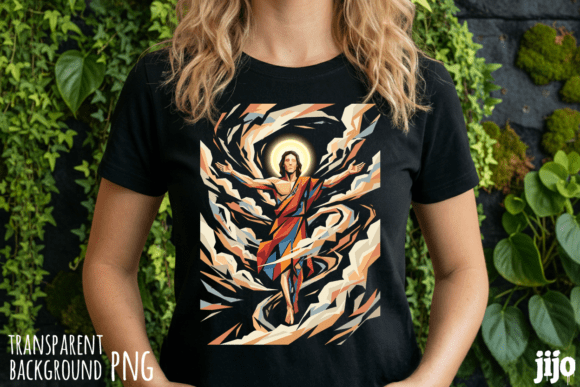
Christian Jesus Halo Abstract PNG
A Designer’s First Glance: Quiet Reverence, Not Religious Cliché
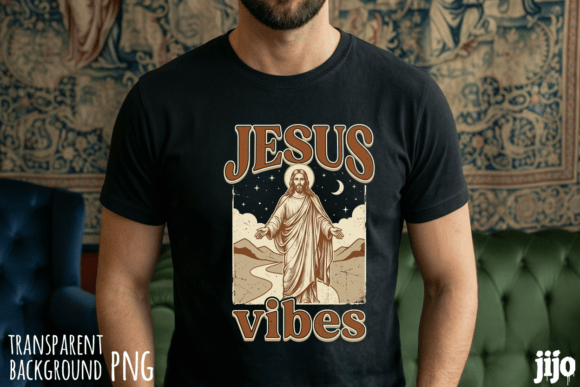
When Christian Jesus Halo Abstract PNG opened on my screen, I didn’t see a devotional cliché—I saw restrained symbolism. The halo isn’t a rigid gold ring; it’s a soft, asymmetrical gradient bloom—almost like light diffusing through stained glass. Jesus’ profile is minimal, suggested rather than outlined, with gentle negative space doing most of the work. There’s no cross, no dove, no overt text—just presence, warmth, and quiet dignity. That makes it unusually versatile for T-Shirt Designs, especially when you’re stitching for audiences who value subtlety over statement: new parents choosing nursery decor, boutique owners curating mindful apparel, or crafters making personalized gifts for spiritual-but-not-dogmatic customers.
How It Stitches in Real Life: From Screen to Sweatshirt
I tested Christian Jesus Halo Abstract PNG on a medium-weight cotton sweatshirt—standard 300–400 gsm, brushed interior—and used tear-away stabilizer underneath with a light cutaway overlay at the collar seam. The design held beautifully. Because the halo is built from layered fill stitches—not dense satin borders—it breathed well on the fabric without puckering. The profile’s clean curves translated cleanly into satin stitch, and the abstract glow resolved into soft, even tonal gradation using three closely matched thread colors (ivory, warm beige, pale gold). No skipped stitches, no thread breaks—even at moderate speed (650 spm).
This isn’t a design that shouts. It whispers. So it shines brightest on products where quiet intention matters: embroidered baby onesies (gentle enough for sensitive skin), linen pillow covers for a calming bedroom, tea towels for a faith-based kitchen shop, or minimalist tote bags sold at local craft fairs. As a machine embroidery design, it avoids the pitfalls of overly literal religious iconography—no tiny hands to distort, no fine lettering to blur, no sharp angles that snag during wear. That makes it safer for commercial embroidery runs and more forgiving for Etsy sellers managing multiple fabric types across orders.
Where Caution Is Warranted: Know Its Limits
Christian Jesus Halo Abstract PNG doesn’t love every surface. On highly textured fabrics—like thick terry cloth towels or nubby bouclé caps—the subtle halo gradients can blur into indistinct smudges. On stretchy knits (think lightweight jersey tees), you’ll need excellent stabilization—ideally a cutaway + topping combo—to prevent distortion around the curved profile edge. And while it reads clearly on light and mid-tone fabrics, avoid it on very dark backgrounds unless you’re willing to add an underlay or switch to high-contrast thread (e.g., cream on navy instead of ivory on black). The design’s strength lies in its softness—not its boldness.
Also: skip tight hoop sizes under 4×4 inches. The halo’s gentle expansion needs breathing room. If you’re planning a custom apparel run on baseball caps, reconsider—curved surfaces compress delicate gradients, and the lack of hard edges means detail can vanish at the crown seam. Likewise, avoid using it as a standalone embroidered patch smaller than 3.5 inches wide; the abstraction relies on scale to communicate meaning.
What It Adds to Your Finished Product—Beyond Aesthetics
There’s tangible value in how Christian Jesus Halo Abstract PNG elevates perception. When stitched onto a handmade apron for a Christian baker’s small shop, it signals care—not just craft. Customers notice the restraint. They trust it more than a busy, clip-art-style cross. That builds brand consistency for faith-aligned businesses without leaning into kitsch. For personalized gifts, it offers emotional resonance without prescriptive messaging—ideal for baptisms, confirmations, or quiet milestone celebrations where “faith” means something deeply personal, not performative.
It also supports handmade presentation. Because the design avoids excessive density, it lies flat, wears comfortably, and survives repeated washing better than tightly packed fill-stitch motifs. That translates directly to customer retention—fewer returns, more repeat buyers, stronger word-of-mouth among church groups or homeschool co-ops looking for quality small shop products.
Practical Notes Every Embroidery Designer Should Run Through
- Always test first—stitch Christian Jesus Halo Abstract PNG on scrap fabric matching your final project’s weight and stretch.
- Check thread color contrast in natural light—not just on-screen. What looks distinct digitally may blend on fabric.
- Review stitch density: this design leans moderate, but verify no overlapping fills cause buildup on lightweight cotton or baby items.
- Confirm hoop size compatibility before digitizing or auto-hooping—some versions may assume 5×7 or larger.
- Inspect small details in your embroidery software: does the halo’s outer edge taper cleanly? Are there stray jump stitches near the profile’s temple?
- Test in black and white mockups—abstraction relies on tonal nuance, not color alone.
- Compare performance on light vs. dark fabric backgrounds using real thread samples, not just RGB previews.
- Use proper stabilizer: tear-away works for stable wovens; cutaway + topping is non-negotiable for knits or textured weaves.
- Verify licensing before selling finished items—if this is a digital embroidery file, confirm whether commercial use is permitted for your craft business.
Final Thought: A Design That Earns Its Place
Christian Jesus Halo Abstract PNG won’t dominate a tradeshow booth—but it will linger in a customer’s memory after they unroll a linen tea towel or lift a baby blanket stitched with quiet reverence. It’s not flashy. It’s not trend-chasing. It’s thoughtfully calibrated for real-world embroidery: forgiving on machines, respectful of fabric, and emotionally resonant without being prescriptive. For small business owners, apparel decorators, and creative entrepreneurs building meaningful collections—not just inventory—it’s the kind of design assets that quietly strengthens trust, deepens connection, and turns a simple finished product into something quietly sacred. Just remember: let it breathe, stabilize well, and choose the fabric with intention. Then stitch with care.